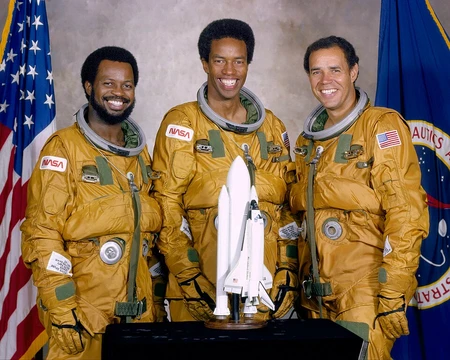
Harrison Schmitt
Geologist, Apollo 17 astronaut, and former U.S. senator.

via Wikipedia: Harrison Schmitt · see source
Harrison Hagan "Jack" Schmitt (born July 3, 1935) is an American geologist, former NASA astronaut, university professor, and former U.S. senator from New Mexico. He is the most recent living person—and only person without a background in military aviation—to have walked on the Moon. In December 1972, as a crewmember of Apollo 17, Schmitt became the first member of NASA's first scientist-astronaut group to fly in space. As Apollo 17 was the last of the Apollo missions, he became the twelfth and second-youngest person to walk on the Moon and the second-to-last person to step off the Moon. Schmitt remains the only professional scientist to have landed on the Moon.
- born
- July 3, 1935
- field
- Geology, astronautics, politics
- nationality
- American
- known_for
- Twelfth person to walk on the Moon; only professional scientist to land on the M
Verified Timeline
Lore & Background
Schmitt was born July 3, 1935, in Santa Rita, New Mexico, and grew up in nearby Silver City. He earned a B.S. in geology from Caltech in 1957, studied at the University of Oslo as a Fulbright Scholar, and received a Ph.D. in geology from Harvard in 1964. Before joining NASA as a member of the first scientist-astronaut group in June 1965, he worked at the U.S. Geological Survey's Astrogeology Center developing geological field techniques for Apollo crews. After spending his first year at Air Force UPT learning to be a jet pilot, he played a key role in training Apollo crews to be geologic observers in lunar orbit and competent field workers on the surface. He also participated in examining returned lunar samples and helping crews with scientific aspects of mission reports. Schmitt was assigned to Apollo 17 in August 1971 after Apollo 18 and 19 were canceled, replacing Joe Engle as Lunar Module Pilot. He landed on the Moon with commander Gene Cernan in December 1972. While on the surface, he collected Troctolite 76535, called "without doubt the most interesting sample returned from the Moon" and central evidence that the Moon once had an active magnetic field. He is the next-to-last person to have walked on the Moon, as he returned to the Lunar Module before Cernan. After the mission, he documented Apollo geologic results and organized NASA's Energy Program Office. On April 29, 2018, the Schmitt Space Communicator SC-1x, named in his honor, was carried aboard a Blue Origin New Shepard capsule, launching the first commercial two-way data and Wi-Fi hotspot service in space. Schmitt resigned from NASA on August 30, 1975, to run for the U.S. Senate as a Republican from New Mexico. He defeated Democratic incumbent Joseph Montoya in the 1976 election, 57% to 43%. He served one term, chairing the Science, Technology, and Space Subcommittee, but was defeated in 1982 by Democrat Jeff Bingaman, 54% to 46%. After his Senate term, he became a consultant, adjunct professor at the University of Wisconsin–Madison, and chair of the NASA Advisory Council until his resignation on October 16, 2008. He has rejected the scientific consensus on climate change, claiming it is predominantly caused by natural factors and that the "global warming scare" is used as a political tool.
Reader's Guide
Harrison Schmitt's significance lies in his unique combination of scientific expertise and spaceflight experience. As the only professional geologist to walk on the Moon, he directly advanced lunar science by collecting samples like Troctolite 76535, which provided key evidence about the Moon's magnetic history. His role on Apollo 17, the final Apollo mission, made him the second-to-last person to step off the Moon and, after Cernan's death in 2017, the most recent living person to have walked on the Moon. Schmitt's transition from astronaut to U.S. senator demonstrated the public appeal of space explorers in politics, though his single term reflected the challenges of translating that appeal into sustained electoral success—his 1982 opponent's slogan asked, "What on Earth has he done for you lately?" His post-Senate advocacy for lunar resource utilization, including helium-3 for fusion, and his controversial climate change views have kept him a figure of debate. The Schmitt Space Communicator SC-1x, named in his honor and launched in 2018, highlights his ongoing connection to space technology. Overall, Schmitt represents the intersection of scientific inquiry, human space exploration, and public policy, with a legacy shaped by both his lunar achievements and his political and environmental stances.
Did You Know?
- Schmitt is the only person without a background in military aviation to have walked on the Moon.
- He collected Troctolite 76535, called 'without doubt the most interesting sample returned from the Moon,' which suggests the Moon once had an active magnetic field.
- Schmitt claims to have taken the famous 'Blue Marble' photograph of Earth, though his Apollo 17 crewmates and NASA credit all three together.
- He resigned from the Planetary Society in November 2008 over disagreements on Mars-first exploration, climate change policy, and international cooperation.
- The Schmitt Space Communicator SC-1x, named in his honor, sent the first commercial Twitter message from space in 2018.
Frequently Asked Questions
Who is Harrison Schmitt?
Harrison Hagan 'Jack' Schmitt (born July 3, 1935) is an American geologist, former NASA astronaut, and former U.S. senator from New Mexico. He is best known as the twelfth person to walk on the Moon during the Apollo 17 mission in December 1972.
What made Harrison Schmitt's Apollo 17 mission unique?
He was the first scientist-astronaut to fly in space and remains the only professional scientist ever to land on the lunar surface. Unlike every other Apollo crew member, his qualifications came from a geology career rather than military aviation.
Why is Harrison Schmitt important to space exploration?
His selection proved that a career scientist could meet the physical and operational demands of a lunar landing, breaking the pattern of military pilots dominating the astronaut corps. His geological expertise directly shaped the sample-collection strategy that made Apollo 17 the most scientifically productive Moon landing.
What did Harrison Schmitt do after his NASA career?
He resumed work as a university professor and continued serving as a U.S. senator from New Mexico until 1977. In the decades since, he has remained a vocal public advocate for space exploration and scientific education.
Is Harrison Schmitt still alive?
Yes, he was born on July 3, 1935, and he remains the most recent living person to have walked on the Moon. Because Apollo 17 was the final lunar landing, he holds that distinction permanently.
More in Astronauts And Space Pioneers 1-20
Spotted an error? Know more?
This is a living reference — every entry is fact-audited, and reader corrections feed straight into our audit queue. Suggest an edit · See this site's audit record